



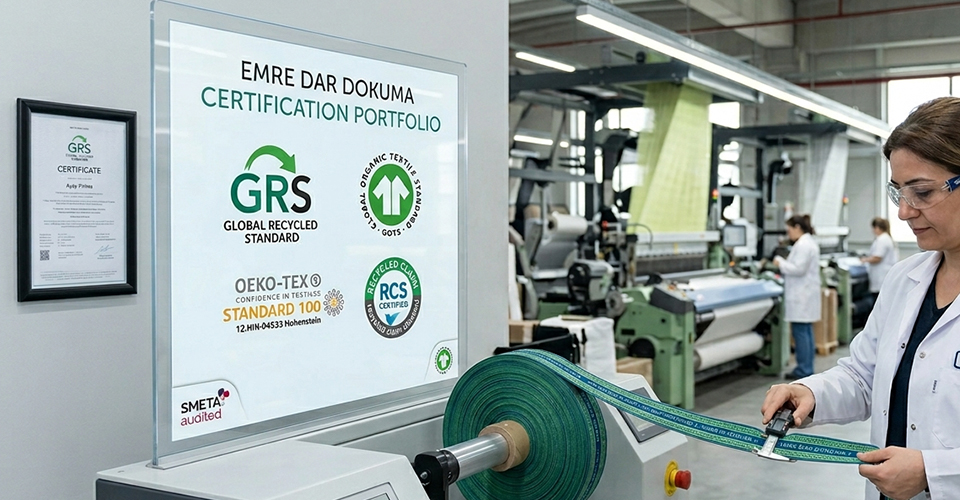
Narrow Woven Fabric Production Certificates
If a textile product’s label bears the OEKO-TEX, GOTS, or
GRS logo, that label is more than just a logo; it’s a summary explaining how
the production chain operates and what audits it has undergone. Narrow-woven
fabric production certificates provide important details that offer general
information ranging from a company’s reliability to product quality. Woven
trims—such as ribbons, elastic bands, cords, and label tapes—are small yet
critical components of a garment. If these small components are not certified,
the certification of the main product is also put at risk. This is why brands
request the certification file from the very first day when selecting a
supplier. In this article, we wanted to share with you the fundamental
certifications applicable in narrow weaving production, what specific
requirements each brand demands, and what to look for when selecting a
supplier.
Why Are Textile Certifications Important?
Textile certifications are important because they signify that an independent audit organization has visited the facility to document and verify chemical usage, raw material traceability, working conditions, and waste management. This audit has three practical implications.
First, it has become a mandatory requirement for exports. A European buyer will not even include a product that is not REACH and ZDHC compliant in the purchasing process. Second, major brands only open their purchasing channels to certified suppliers. For example, companies like Inditex, H&M, and Decathlon do not include manufacturers without certification in their supplier pools. Third, the end consumer is now reading the label. Especially in the baby textiles, underwear, and sports segments, certification directly influences perception.
OEKO-TEX Certification
The OEKO-TEX Standard 100 is the most widely recognized certification for both fabrics and textiles. It demonstrates that the product is free from harmful chemicals including azo dyes, heavy metals, formaldehyde, phthalates, and hundreds of other parameters at every stage from raw material to the finished product.
The class in which the product is certified is important. Woven fabrics used for baby and children’s textiles fall under Class 1, and the strictest limits apply in this category. Underwear, sportswear, and products in direct skin contact fall under Class 2; outerwear and accessories under Class 3; and home textiles under Class 4. This certification is renewed annually. Samples taken each year are tested; if the results exceed the limits, the certificate is suspended.
GOTS Certification
GOTS Certification (Global Organic Textile Standard) is one of the strictest standards focused on organic fibers. For a product to be GOTS-labeled, both the raw material must come from organic farming and the production chain must operate using environmentally friendly methods.
In the context of narrow weaving, this means: The yarn used to weave the cotton fabric must be certified organic; your dyehouse must use GOTS-approved chemicals; and wastewater must not be discharged without treatment. GOTS also audits the facility’s social conditions, covering issues such as child labor, forced labor, and wage practices. There are also two certification levels: “organic” (at least 95% organic fiber) and “made with organic materials” (70–95%).
GRS Certification
The GRS Certificate (Global Recycled Standard) is a chain-of-custody standard that verifies that recycled content is genuinely recycled. This is the certification you’ll encounter most frequently in narrow fabrics, as nearly every new “green” ribbon, elastic, and label on the market typically comes with a GRS certificate.
The scope of the certificate extends beyond just the percentage of recycled raw materials. It also includes requirements for social responsibility, environmental compliance, and chemical restrictions. This is exactly the certification a brand looking to purchase recycled polyester tape seeks. The minimum recycled content for GRS is 20%. However, to qualify for the “GRS 100” label, the product must contain over 95% recycled material.
OCS Certification
The OCS Certification (Organic Content Standard) can be considered a more flexible version of GOTS. The focus here narrows down to a single point: verifying the percentage of organic fibers in the product.
The difference from GOTS is that it does not audit the entire production process (dyeing, wastewater, social conditions). OCS confirms that the raw material is organic and remains traceable all the way to the final product. For this reason, companies taking their first steps toward sustainability typically start with OCS and then move on to GOTS. There are two labels under OCS: “OCS 100” (95% or higher organic content) and “OCS Blended” (a blend of 5% to 95% organic content).
RCS Certification
The RCS Certification (Recycled Claim Standard) is essentially the “little brother” of GRS. It only verifies the amount of recycled content and supply chain traceability; it excludes social conditions and environmental criteria.
It is generally used by manufacturers who use recycled raw materials in small batches or are planning a gradual transition to GRS. You can prove how much recycled polyester a narrow-woven label is made from with an RCS certificate, but if the brand makes a “green product” claim, GRS carries more weight.
Sedex (SMETA) Audit
Sedex is not a certification but a membership-based platform. SMETA (Sedex Members Ethical Trade Audit) is the audit method of this platform. The audit is based on four pillars: working conditions, occupational health and safety, environmental management, and business ethics. The auditor visits the facility, reviews records, interviews employees, and uploads the report to the Sedex platform. The brand then views that report on its own dashboard.
Major retailers like Inditex, M&S, and Tesco do not place orders with suppliers without a valid SMETA report. Therefore, even without a Sedex certificate, it is effectively mandatory for export-oriented narrow-fabric manufacturers.
Inditex Standards
Inditex Standards (for brands like Zara, Bershka, Pull&Bear, Massimo Dutti, and Stradivarius) require suppliers to comply with their internal standards. The main framework revolves around a chemical restriction program (RSL/MRSL) known as “The List by Inditex” and quality requirements such as “Health to Wear.”
A single document is not sufficient to become an Inditex-approved supplier:
- A valid OEKO-TEX or equivalent chemical safety certificate
- Social compliance audit (Inditex’s own audit network)
- “Picking” certification, i.e., the supplier’s rating within Inditex’s classification system
A company wishing to produce narrow-woven fabrics for Inditex must fully meet all three of these requirements.

Frequently Asked Questions About Narrow-Woven Production Certifications
Given the scope and importance of this topic, it is necessary to address a few questions under the heading “Frequently Asked Questions About Narrow-Woven Production Certifications.”
Which brands require which certifications?
Priorities vary by brand group.
- H&M, Inditex, C&A, Mango Group: GRS and GOTS are prioritized; OEKO-TEX is a mandatory baseline; Sedex or their own audit networks for social compliance.
- Nike, Adidas, Puma, Under Armour: Bluesign and OEKO-TEX for chemical safety; ZDHC MRSL compliance is mandatory; FLA or Sedex for social compliance.
- Decathlon, Lidl, Aldi (private labels): OEKO-TEX is mandatory; GRS and GOTS are required for sustainability collections; amfori BSCI audits are common for social compliance.
- Luxury segment (Hermès, Burberry, Prada): Primarily rely on in-house laboratory tests and specialized supplier audits; they focus more on brand-specific requirements than standardized certifications.
Differences between OEKO-TEX, GOTS, and GRS
These three certifications are often confused, but they actually address three distinct questions. The practical rule is: OEKO-TEX ensures health safety, GOTS ensures organic standards, and GRS ensures recycling standards.
Certification | The main focus | Raw material requirements | Does it include social compliance? |
OEKO-TEX | Are there harmful chemicals in the product? | No, any raw material is acceptable | No (STeP is separate) |
GOTS | Is the raw material organic and is production eco-friendly? | 70%+ organic fiber | Yes |
GRS | Is the raw material recycled? | 20%+ recycled | Yes |
Key Considerations When Selecting a Certified Supplier
One of the most important details is what to look for when selecting a certified supplier. There are three things to check when the certification document arrives.
- First, the document’s validity date. OEKO-TEX is annual, GOTS is annual, GRS is annual; all are time-limited. A document whose validity has expired has no practical value.
- Second is the scope of the certificate (Scope Certificate). The document specifies exactly which products the supplier is certified for. If the certificate covers “polyester tape,” it may not cover cotton tape. A certificate with an incorrect scope will be rejected during an audit.
- Third is the Transaction Certificate. This is a document issued separately for each shipment, confirming that the shipped batch is certified. You should not accept the Scope Certificate without confirming whether the supplier can issue this certificate. The Scope Certificate only indicates that the facility is certified, not the shipment itself.
The Role of Sustainability, Recycling, and Organic Production in Textiles
The textile industry is one of the world’s largest consumers of water and a major contributor to chemical emissions. The fast fashion model has amplified this burden on a massive scale; sustainable production, however, is emerging as a counter-movement precisely at this juncture.
While narrow fabrics may not seem significant on their own in this equation, they contribute to the overall impact. Millions of T-shirts are produced annually; each contains 1–2 meters of neckband, 1 meter of elastic, and 1 meter of label. The total of these small components amounts to thousands of tons of raw materials annually.
Recycled polyester tape requires a significantly lower amount of energy during production compared to virgin polyester; CO₂ emissions from its production also decrease. Water consumption in organic cotton is substantially lower than in conventional cotton (these differences are published in Textile Exchange’s annual reports). When these differences are multiplied by the small yardage of narrow fabrics, they translate into large numbers.
Brands have committed to sourcing a significant portion of their production from sustainable sources by 2030. These goals also cover auxiliary materials. In other words, whether a narrow-width fabric manufacturer has established a sustainable production infrastructure will determine whether they can enter the market in the next five years.
Are certified narrow-width fabric products more expensive?
This is one of the most frequently asked questions. The price of certified raw materials is generally 10–30% higher than that of virgin alternatives. However, this difference pays off for the customer when reflected in the export price. Markets where uncertified products could not be sold are now selling the certified versions.
Does the OEKO-TEX certificate need to be renewed annually?
Yes. The OEKO-TEX certificate is valid for 12 months. Every year, sample testing is conducted by an independent laboratory, and the certificate is renewed if the results are satisfactory. Additional testing may be required if there are changes in production parameters (such as a new dyeing facility or a new raw material supplier).
Can small businesses obtain GRS certification?
Yes, they can. GRS has no prerequisites regarding business size. The main requirement is that every link in the chain—from the supplier of recycled raw materials to the final product—must be certified. Whether it’s a three-person workshop or a 200-person factory, both can obtain the certification if they meet the same conditions. Certification bodies offer audit packages tailored to small businesses.
What is the main difference between OCS and GOTS?
OCS only verifies the organic content percentage. GOTS goes further by auditing the production process, chemicals used, social conditions, and waste management. Brands generally consider OCS sufficient as a first step; however, GOTS is expected for collections claiming to be “fully sustainable.”
How is a certification number verified?
Every certification has its own verification page on its official website. For OEKO-TEX, use the “Label Check” on oekotex.com; for GOTS, use the certification database on global-standard.org; and for GRS, use the public registry on textileexchange.org. It takes about 30 seconds to enter the certificate number provided by the supplier and verify it.
Emre Dar Textiles Certifications
Emre Dar Textiles operates under the OEKO-TEX Standard 100 certification. Additionally, our recycled polyester products are certified under GRS, and our organic cotton ribbons are certified under GOTS. On the social compliance side, we undergo Sedex (SMETA) audits; within the Inditex supplier network, we hold a “Picking” certified status.
We share which products fall under which certification scope and the valid Scope Certificates / Transaction Certificates prior to ordering. If you are selecting sustainable raw materials for a new collection, we can work together to match certifications on a product-by-product basis.
